Home Upcoming grant deadlines The 2027-2028 Fulbright Student Award
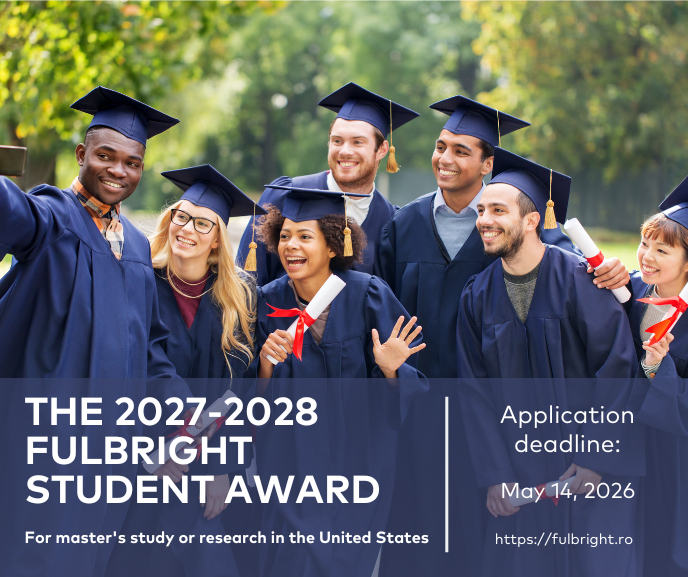
The Romanian-U.S. Fulbright Commission is pleased to announce the 2027-2028 Fulbright Student Award competition for master’s study or research in the United States. Applicants can be Romanian graduates – BA, MA or PhD students – from accredited public and private universities. BA students are also invited to apply if they are in their final year of undergraduate study.
Eligible fields: any academic field except the clinical ones (i.e. those which include patient contact).
Grant duration:
The U.S. academic year usually starts in mid-August. The ongoing Fulbright Student competition is for grants in the 2027-2028 academic year.
Second-year costs for the Romanian Fulbright master’s students may be covered depending on funds availability as well as on proof of good academic standing during the first year of study.
The Fulbright Student Award provides: international travel, tuition and university fees within established budget limits, monthly stipend for accommodation and living expenses, books and supplies allowance, settling-in allowance, and ASPE (Accident and Sickness Program for Exchanges) health benefits plan.
Romanian citizens who are currently residing in the U.S., have been residents in the U.S. for five or more years in the previous six years, or have recently graduated from a U.S. academic institution are ineligible to apply. Students already in the United States are ineligible for a grant. The preference for candidates without extensive previous experience in the U.S. applies at each stage of competition.
Standardized tests are not obligatory in the first stages of the competition. Score reports will be required prior to October 30, 2026. Test vouchers for exam registration will be provided only to the Romanian final nominees who must take TOEFL (for research) and TOEFL, GRE or GMAT (for master’s degree).
The standard format of the letter of recommendation is accessible in editable version here.
The applicants are strongly encouraged to refer
to the application instructions here
Additional details about the selection process are available in the general description of the program: https://fulbright.ro/grant/the-fulbright-student-program
Only online applications will be accepted. Incomplete applications lead to exclusion of the respective applicant from further selection process. Paper documents will not be returned.
Researchers applying for a Fulbright Student Award are strongly encouraged to read the information HERE.
Follow the News section of the website for announcements on webinars and online presentations about the Fulbright Student Program & graduate studies in the U.S.!
February
Competition opens
March – April
Presentations & webinars
Early May
Application deadline
May – August
Assessment phase
late August – early September
Short-listed candidates are invited to the interview
Mid-September
Interviews
October
Notifications; finalist applications are sent to IIE in New York
November-May
Admission and placement of candidates carried out by IIE and the Fulbright Commission
May-August
Fulbright Terms of Appointment are signed; J1 visa paperwork
Early July
Pre-Departure Orientation
July – September
Fulbright exchanges begin
The Fulbright Student award covers tuition for MA students, university fees for Student Researchers, as well as a monthly stipend for accommodation and living expenses. The grant also includes accident/sickness coverage and covers international travel costs to and from the U.S. (roundtrip ticket).
In addition, the Fulbright Commission offers all the grantees one day Orientation Program as pre-departure assistance, in July. While in the U.S., the Fulbright grantees receive further support from the Institute of International Education (IIE).
Approximately 10 Fulbright Student awards, depending on the annual budget of the Commission. This means that the number of awards is not fixed and can vary depending on the available resources and tuition fees inflation.
For master’s programs, the maximum funding per grant is $66,000 for one academic year (9 months) plus $1800 for the international travel (roundtrip airfare). The grantees can contribute to covering expenses.
The Fulbright grant is designed for the first academic year. Second-year costs for the Romanian Fulbright degree-seeking (master’s) students may be covered depending on funds availability as well as on proof of good academic standing during the first year of study.
No. Fulbright Awards are not deferrable. Candidates are recommended to reapply in this case.
Yes. Only Romanian citizens can apply to the program administered by the Fulbright Commission in Romania. Green card holders are not eligible.
No. But you may apply for a Fulbright grant as an American citizen.
No. Fulbright grants to Romanian citizens are awarded only for studies in the United States of America.
No. Being admitted by an American university is not a prerequisite for the Romanian applicants to Fulbright Student Award.
The candidates are strongly encouraged to mention their university options in the application form.
After the Fulbright selection process is concluded, the Institute of International Education in New York (IIE) will team up with the Fulbright Commission for the admission and affiliation of the Romanian finalists to accredited U.S. universities. IIE will communicate with the U.S. universities on behalf of the Romanian finalists. The U.S. universities are established for each nominated finalist on the basis of a submission plan proposed by IIE and agreed by the finalist. Finalist’s initial preferences will be considered as well, depending on the program suitability and financial flexibility of the university proposed by the candidate.
If you do not receive admission from any U.S. university, the offer of a Fulbright Student Award will be withdrawn.
No. Romanian candidates or finalists already studying or doing research in the U.S. are not eligible for a Fulbright grant.
The letters of recommendation will be considered only if they are sent by the deadline.
Applicants who wish to pursue studies as medical students are not eligible. Applicants with medical degrees may receive grants for research or advanced academic study, but not for internships or residencies.
If an applicant has or will receive a PhD prior to his/her Fulbright year in the U.S., he/she is strongly recommended to apply in the Visiting Scholar category. Please check the timeline along with the information referring to the Fulbright Visiting Scholar Program.
All non-U.S. Fulbright grantees are required to travel on “J” visas under Exchange-Visitor Program (Number G-1-00001) for the duration of their financial sponsorship. As a condition of the “J” visa, after completion of the academic program, students must return to Romania and live in the home country for two years before being eligible to immigrate, apply for permanent residence or for a work permit in the United States.
Yes. Applicants who have had previous U.S. study experience may receive awards, but preference is given to applicants without such experience.
As a rule, this message is intended to ensure that you meet the minimum eligibility requirements. If you follow the online instructions for Romanian Fulbright Student applicants and the information included in the official competition announcement published annually on our website, you do not need to contact the Commission; you may continue with your application.
Along the admission and affiliation process, the Romanian finalists are strongly advised to avoid communication on topics such as admission process, financial matters, funding, and visa issues with the U.S. university representatives. The admission and affiliation process to the U.S. universities is managed by the Institute of International Education in New York in collaboration with the Fulbright Commission and all these matters will be agreed with the U.S. universities by these two organizations. Personal communication with U.S. universities would jeopardize admission and affiliation, leading to cancellation of the grant.
Yes, students in their final year of undergraduate study are also allowed to apply, provided they receive the graduation diploma by September (the year of application) and can demonstrate this with relevant documents such as complete transcripts and diploma/certificate of graduation.
For the peer screening, the applications are reviewed by two specialists in their respective field (as a rule, an American and a Romanian specialist). The peer evaluation of the professional level of the applicant’s proposal is based on the following criteria: importance of the proposed topic to the home country and to the field, clarity and value of the required essays, feasibility of the proposal, academic credentials, evidence that research in the U.S. is necessary to fulfill the proposed goals and plans to implement the acquired professional experience or disseminate research findings in Romania after conclusion of the grant.
For the interview phase, a nomination committee composed of American and Romanian members will evaluate the candidates focusing on specific aspects such as motivation, adaptability, project impact and benefit for the home country. As a rule, the interview committee members are senior academics and accomplished professionals, U.S. Embassy representatives, and Fulbright alumni.
The letters of recommendation should provide accurate, relevant information and add to the activities and accomplishments in the resume or to the ideas emphasized in the applicant’s essays. The three letters requested to Fulbright applicants will include: applicant’s full name, field of study and country of application as well as recommender’s contacts, full name, title and signature along with a brief description of recommender’s qualifications. The reference should also include: recommender’s insight of the applicant’s skills and academic performance (at individual and group level), along with specific examples of strengths and qualifications; an evaluation of the applicant’s commitment to the field and ability to handle the major concepts and themes of the program; comments on the applicant’s character, emotional maturity, responsibility and exercise of leadership, sense of fair-play; comments on the achievability of the proposed study/research objectives; reasons why the applicant deserves the Fulbright grant and why his/her presence in the U.S. is necessary. The reviewers expect to find evidence that the applicant has attained high academic level and excellence in his/her field of knowledge.
Approach recommenders a few months ahead of the application deadline so that they have enough time to write the letter. Provide them with an updated version of your resume or CV, the profile of the institution/department you intend to apply, as well as other useful documents such as transcripts. We also suggest that recommenders read the applicant’s statement of purpose. The references should come from university professors and/or other acknowledged Romanian or foreign professionals, usually from academics who know/have known you well in class and from people who know you well outside class (professional environment as well as extracurricular activities or volunteering). Stay in touch with your recommenders throughout the process and make sure you provide whatever information they need.
Yes. Student Fulbrighters can be accompanied by family members. However, the Fulbrighter must provide evidence, such as personal declaration and bank statement, to demonstrate that dependents can sustain themselves, regardless of Fulbright grant that serves only for grantee’s study purposes. Grantees accompanied by dependents must provide adequate health and accident insurance for the accompanying family. Failure to do so violates the terms and conditions of award and may result in termination of the grantee’s program.
Unfortunately, no. Each year the number of well-qualified applicants exceeds the number of grants available. It is the policy of the Fulbright Foreign Scholarship Board not to give to individual applicants, to others inquiring on their behalf, or to the public generally, the specific reasons for selection or non-selection of applicants for awards.
Yes, all the applicants are notified.
To provide the best experience, we use technologies such as cookies to store and access device information. Your consent helps us process data like browsing behavior or unique IDs. If you do not consent or withdraw consent, some features may not function as intended.